




Towing Safety Guide: Tips for Safe Trailering
Towing Safety Guide: Tips for Safe Trailering
Whether you’re hauling equipment to a job site, launching a boat, or rolling into a campsite, there are a lot of reasons you might be towing. You need a vehicle that can carry the load safely and securely, because a trailer doesn’t just add weight. It changes everything about how your vehicle moves. Your acceleration slows down, your braking distance increases, and your handling demands sharper attention. One unprepared moment on the road can quickly turn an everyday haul into a dangerous situation.
The good news? Staying safe while towing isn’t complicated! You just need the right knowledge. Understanding your vehicle’s towing capacity, pairing it with the right equipment, and making a few smart driving adjustments can make all the difference.
That’s exactly what this guide is here for. Read on for the essential towing tips every driver should know before hitting the road.
Know Your Vehicle’s Towing Capacity
Every truck or SUV has a maximum towing capacity, and going over that limit can mean poor performance and even serious safety risks.
What you might not know is that towing capacity isn’t a single number, but a combination of ratings that work together to keep you safe on the road. Before you hitch up, make sure you understand all three:
- Maximum Towing CapacityThis is the total weight your vehicle can safely pull, trailer and cargo included. If you go over it, you’ll put extra strain on your engine and compromise your brakes, suspension, and control.
- Payload CapacityThis covers everything your vehicle carries, including passengers, gear inside the cabin, and the tongue weight pressing down from the hitch. It’s easy to overlook, but pushing past it can quickly throw off your handling.
- Tongue WeightRoughly 10–15% of your trailer’s total weight should press down on the hitch ball. Too little weight, and the trailer can sway. Too much weight, and your front wheels lose traction and steering response. It’s one of the most important factors in keeping your rig stable at highway speeds.
It’s also worth noting that towing capacity isn’t one-size-fits-all, even within the same model line. On Ram trucks and Jeep SUVs, ratings can shift significantly based on engine choice, drivetrain, axle ratio, and how the vehicle is configured from the factory. Always check your owner’s manual or door jamb sticker to confirm your specific numbers before you hook anything up.
Know Your Trailer and Its Limits
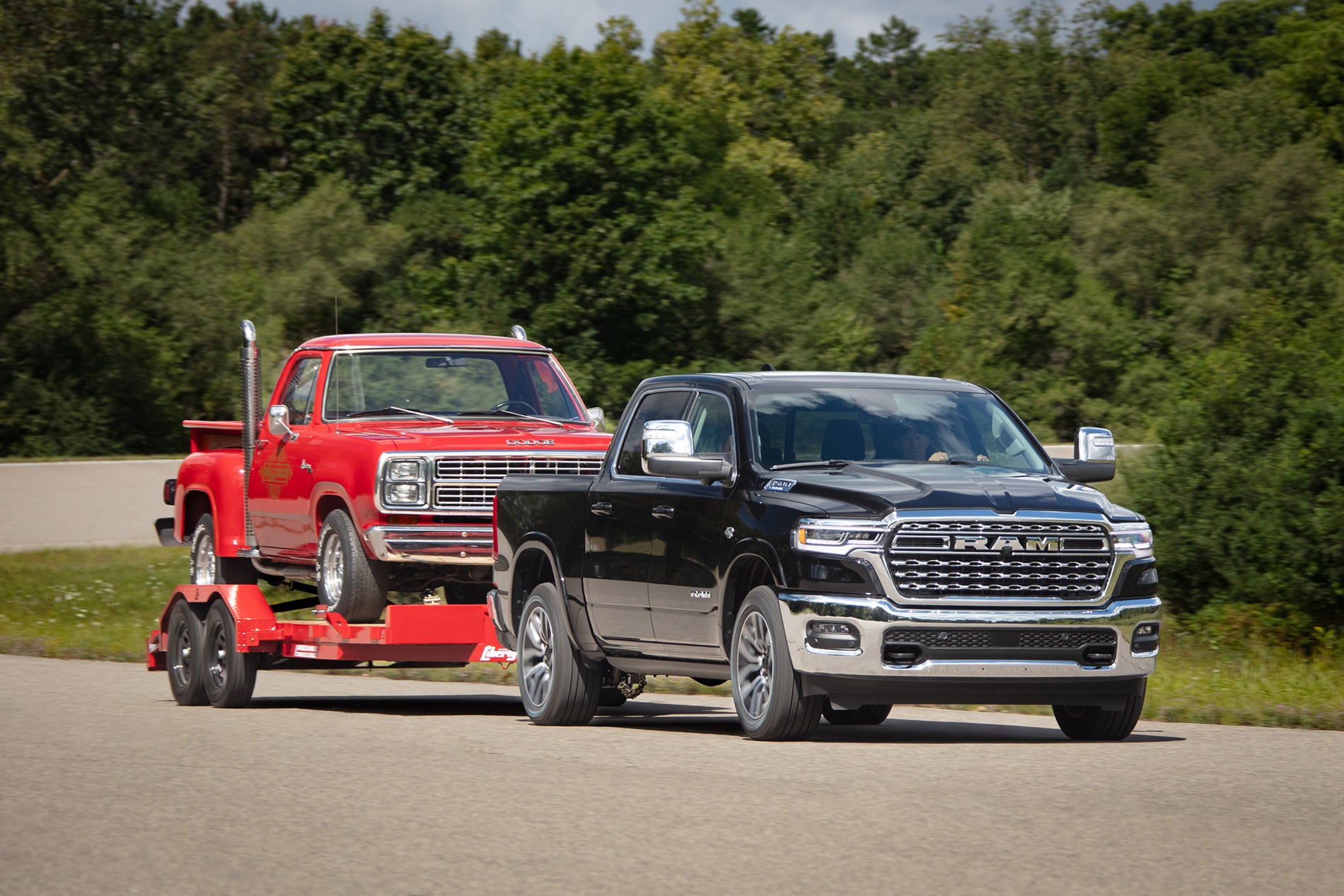
Your vehicle’s ratings are only half the equation. Before you pull out of the driveway, you need to know your trailer just as well as you know your truck.
Every trailer has its own weight, dimensions, and quirks that directly affect how your whole rig handles on the road. Ignoring those details makes towing harder and even dangerous.
Start with the basics: does your loaded trailer actually fall within your vehicle’s towing capacity? Every piece of cargo counts. But beyond the total weight, how that weight is distributed matters just as much. Too much load shifted toward the rear of the trailer can cause it to sway, while a front-heavy load puts excessive pressure on the hitch. Aim to keep roughly 60% of your cargo weight toward the front of the trailer for the best balance and control.
The length and height of your trailer are also key. A longer trailer isn’t just harder to park; it changes your entire approach to driving. Wide turns are a necessity, and stopping distances are longer than you might expect. When it comes to height, gas station canopies or low bridges require extra attention…and maybe an alternate route.
If you’re towing a trailer for the first time, or returning to it after a long break, don’t just assume you’ll figure it out on the highway. Spend a few minutes in an empty parking lot. Practice turning, braking, and backing up. A little time getting reacquainted with your rig can mean the difference between a confident ride and a stressful one.
Use the Right Hitch and Equipment
When you hook up a trailer, getting it attached is only half of the equation. You also need to make sure every piece of equipment is the right fit, properly installed, and ready to perform.
It all starts at the connection point: the hitch. Your hitch needs to be rated for your trailer’s weight, and your ball mount needs to match your trailer’s coupler size. Using mismatched or underrated hardware is a safety risk that can have serious consequences at highway speeds. When in doubt, consult your owner’s manual or talk to a qualified installer before you hook anything up.
Once your hitch is sorted, make sure your trailer is fully integrated into your vehicle’s electrical system. Brake lights, turn signals, and running lights need to function exactly as they do on your vehicle. Other drivers depend on those signals to anticipate your moves, especially when you’re slowing down or making wide turns with a loaded trailer behind you.
Some of the most important safety equipment is easy to overlook. Safety chains serve as a critical backup if the trailer ever separates from the hitch. Be sure to cross them underneath the coupler so the trailer nose doesn’t drop to the ground if they’re needed. If you’re towing a heavier load, a brake controller syncs your trailer’s brakes with your vehicle’s, resulting in significantly shorter stopping distances. And if your trailer blocks your rear view, extended towing mirrors are essential for monitoring traffic and staying aware of trailer sway before it becomes a problem.
Check Tires, Brakes, and Fluids Before Towing
Your vehicle might handle everyday driving without a second thought, but towing is an entirely different challenge. The added weight puts every major system under greater stress, and what might be a minor issue on a routine commute can turn into a serious problem when you’re pulling a loaded trailer down the highway.
A quick pre-trip check of these four areas can save you from a breakdown, a blowout, or worse:
- TiresTowing shifts significant weight onto your tires and generates more heat over long distances. Before every trip, check the pressure on every tire on both your vehicle and your trailer. While you’re at it, inspect the tread and sidewalls for wear, cracking, or any damage that could spell trouble on the road. An underinflated or compromised tire under a heavy load is one of the most common causes of towing accidents.
- BrakesIt takes considerably longer to stop a loaded trailer than it does to stop your vehicle alone. If your brakes are already showing wear, towing will accelerate the problem fast. Make sure your brake pads are in good shape, and if you’re regularly towing heavy loads, consider whether a dedicated trailer brake controller is the right addition to your setup.
- Engine Oil and CoolantTowing puts your engine under more stress and generates more heat than normal driving. Low oil or coolant levels under that kind of stress can push your engine toward overheating, and a breakdown on the side of the road is the best-case scenario if that happens. Check both fluids before you leave, and keep an eye on your temperature gauge once you’re underway.
- TransmissionYour transmission takes on extra strain every time you tow, particularly on hills, in stop-and-go traffic, or in summer heat. If your fluid is dirty or low, that strain becomes a real risk. Check your transmission fluid condition and level before any significant tow, and make sure you’re staying current on transmission service intervals if towing is a regular part of your routine.
If anything looks off during your check, don’t push it. Have it inspected before you hitch up. The cost of a quick service visit is nothing compared to a roadside breakdown or a repair bill from towing beyond your vehicle’s condition.
Balance and Secure Your Load Properly
A trailer that’s loaded incorrectly can become dangerous quickly. Sway, instability, and loss of control result from cargo that wasn’t loaded carefully. Get this part right, and everything else about towing becomes more manageable. Here’s how:
- Stay Within Your GVWREvery trailer has a Gross Vehicle Weight Rating stamped on it. Before you add a single item, know that number and load accordingly.
- Follow the 60/40 RuleWhere your cargo sits matters just as much as how much of it there is. The widely recommended guideline is to place roughly 60% of your load toward the front of the trailer and 40% toward the rear. A rear-heavy load is one of the leading causes of trailer sway, and at highway speeds, this can become disastrous quickly.
- Keep Tongue Weight in the Sweet SpotTongue weight is the downward force your trailer places on the hitch. Generally, it should fall between 10–15% of your trailer’s total loaded weight.
- Don’t Max Out Your CapacityJust because your vehicle is rated to tow a certain weight doesn’t mean you should tow right up to that number. Most towing experts recommend staying within 80–85% of your vehicle’s maximum towing capacity, especially on long highway trips or hilly terrain. That buffer gives your engine, transmission, and brakes room to breathe, and it gives you more margin to respond if conditions change.
- Secure Everything Before You MoveWeight distribution gets your load balanced, and tie-downs keep it that way. Cargo shifts mid-trip can throw off your balance in an instant, turning a well-loaded trailer into an unpredictable one. Use quality straps, ratchet tie-downs, or cargo nets to lock everything in place, and do a quick check at your first stop to make sure nothing has shifted.
Adjust Your Driving When Towing
Driving with a trailer is different from everyday driving, and it’s important to adjust your driving habits accordingly. Here are some of our top tips:
- Allow more distance for stopping, especially at higher speeds.
- Take wider turns at intersections, as trailers tend to cut corners.
- Avoid sudden lane changes or sharp steering inputs that can cause instability.
- Drive at a steady, controlled speed to maintain better control.
- Use lower gears when driving downhill to help manage speed and reduce strain on your brakes.
- Avoid riding the brakes on long descents, as this can lead to overheating.
- Be aware of crosswinds and passing vehicles, which can cause trailer sway.
- Use your mirrors frequently and signal earlier than usual to give other drivers more time to react.
- If your vehicle is equipped with tow/haul mode, use it to improve shifting and overall control while towing.
When to Schedule Service for Towing
If you tow often, staying on top of routine maintenance becomes even more important. The added weight and strain can wear down key systems faster than normal driving, especially your brakes, tires, and cooling components.
In many cases, towing is considered “severe use,” which can shorten standard service intervals and require more frequent checks.
You may want to schedule service if:
- You’ve been towing more frequently than usual.
- You’re overdue for an oil change.
- Your brakes don’t feel as responsive as usual.
- Your tires show uneven wear or low tread.
- You’re getting ready for a longer trip or heavier load.
Prepare Your Vehicle for Towing at Sumter CDJR
If you’re getting ready to tow and wondering how to tow a trailer safely, the team at Sumter Chrysler Dodge Jeep Ram is here to help. From brake inspections and fluid checks to trailer wiring and towing equipment, our service team can get your vehicle ready for the road.
Whether you’re driving a Ram truck, Jeep SUV, or another capable vehicle, our Ram dealership is here to assist with essential safe towing tips. You can also order genuine parts or schedule auto service in Sumter, SC, at a time that works for you!
FAQs
It’s best to stay at or below posted speed limits and adjust as road conditions change. Many drivers find that slightly slower speeds improve control and reduce the risk of sway.
Proper weight distribution, maintaining the correct tongue weight, and avoiding sudden steering movements all help reduce trailer sway. Driving at a steady speed also improves stability.
Trailer brakes are often recommended for heavier loads and may be required depending on the trailer’s weight. They help improve stopping performance and overall control while towing.
You can check your vehicle’s towing capacity in the owner’s manual or on the manufacturer’s specifications label. It’s important to stay within those limits for safe towing.
If your trailer blocks your rear view, extended towing mirrors can improve visibility and help you stay more aware of traffic around you.